Tray Systems in Dental Practices: Efficient Instrument Reprocessing with Wash Trays
A well-organized set of instruments saves time, reduces sources of error, and makes it easier to adhere to standardized hygiene protocols. This is exactly where a tray system comes into play in a dental practice: Instruments are no longer moved around during daily practice in individual, varying combinations, but are instead prepared, used, reprocessed, and made available again as clearly defined sets.
Wash-trays can support the entire instrument cycle—from treatment through mechanical cleaning and disinfection to packaging, sterilization, and storage. However, it is crucial that the trays, instruments, cleaning and disinfection equipment, sterilization containers, and autoclave are coordinated with one another and integrated into the practice’s validated processes.
What is an instrument wash-tray system?
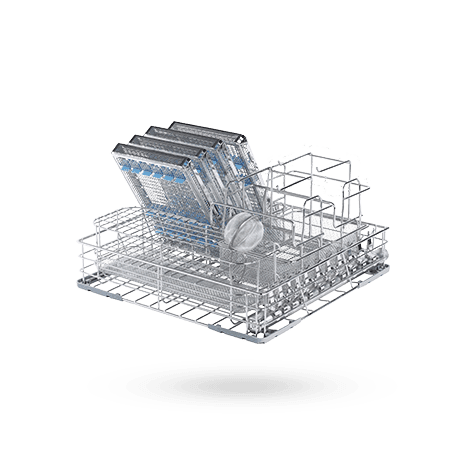
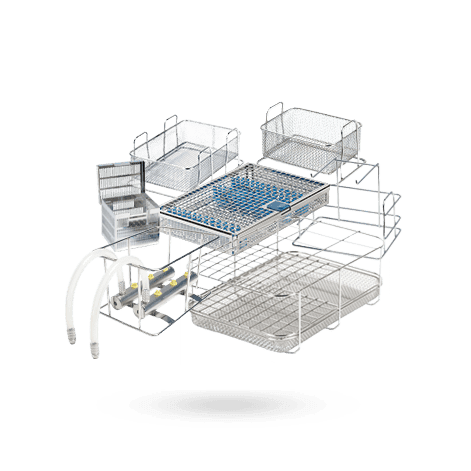
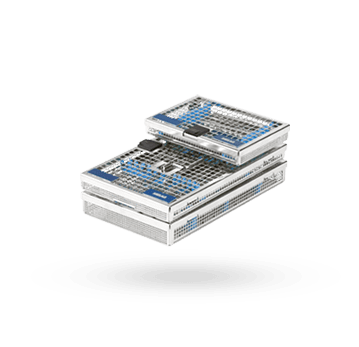
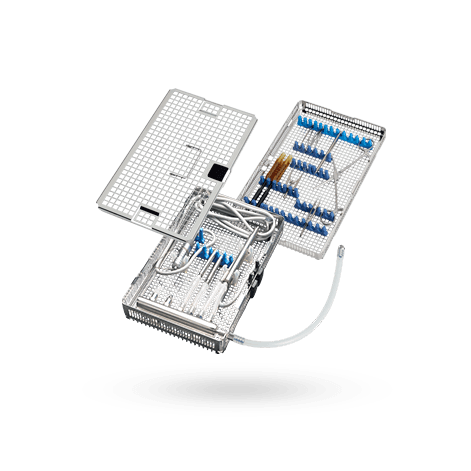
A wash tray is a reusable instrument holder in which the instruments required for a specific procedure are systematically arranged and secured. Depending on the design, flexible silicone dividers or other holders keep the instruments in a defined position.
The wash tray accompanies the instrument set through several stages of reprocessing. It can—provided the manufacturer intends it for this purpose—be used to hold the instruments during mechanical cleaning and disinfection and subsequently within a suitable sterilization container.
However, a wash tray is not automatically considered sterile packaging. Only a sterilization barrier system designed and validated for this purpose—such as a compatible sterilization container with a suitable filter—enables packaged sterilization and protects the sterile items during transport and storage. The requirements for sterile barrier systems and packaging systems are described in DIN EN ISO 11607-1.
Dental Tray, Wash Tray, and Sterilization Container: What’s the Difference?
These terms are sometimes used interchangeably in everyday practice, but they refer to different functions.
A dental tray is primarily an instrument holder designed for organized presentation during treatment. Not every dental tray is automatically suitable for machine cleaning, thermal disinfection, or steam sterilization.
A wash tray is designed for reprocessing in a washer-disinfector. Its design is intended to ensure that water, process chemicals, and the rinsing mechanism can adequately reach the instruments and that liquids can subsequently drain away.
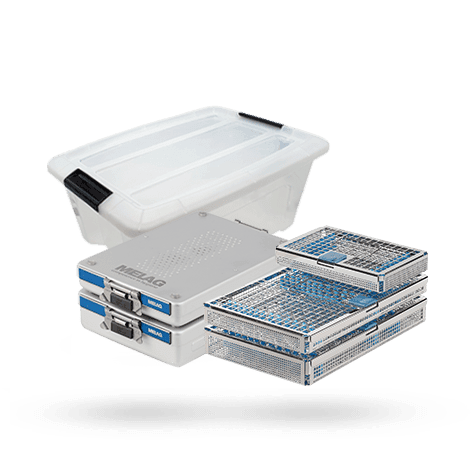
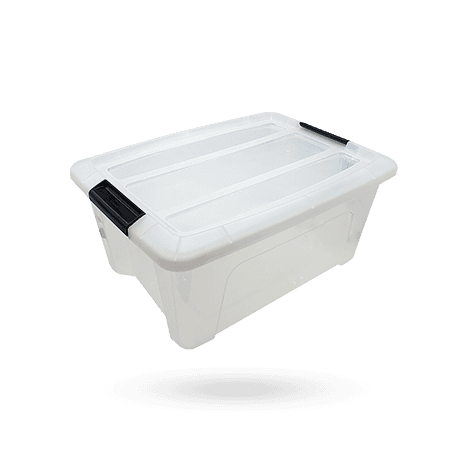
A sterilization container, together with its closure and filter system, serves as the packaging for sterilization. When used as intended, the appropriate sterilization barrier system protects the sterilized instruments from recontamination until they are used.
This creates a coordinated system: The instrument set remains organized in the wash tray, while the container serves as the sterile packaging.
Why is a tray system worthwhile in a dental practice?
Instrument reprocessing involves many repetitive steps. If instruments are sorted, transported, loaded into the washer-disinfector, inspected, and packaged individually, each batch requires a significant amount of manual labor.
A standardized tray system can simplify and standardize these processes
1. Less time required
A fully assembled instrument set is immediately available before treatment. The practice team does not have to search for the required instruments individually from different drawers or containers each time.
Even after treatment, the instruments remain organized as a set. This reduces the steps involved in sorting, loading, and packaging. Coordinated systems consisting of wash trays and sterilization containers are designed to guide instrument sets as seamlessly as possible from use through reprocessing to storage.
2. Standardized Treatment Sets
Fixed sets can be defined for common procedures, such as:
prophylaxis,
conservative treatment,
periodontology,
endodontics,
extractions,
implantology,
oral surgery procedures.
The standardized set design simplifies preparation and quickly reveals whether an instrument is missing. New staff members can also more easily navigate the established set structures.
3. Improved Workplace Safety
Pointed and sharp instruments pose a risk of injury during transport, sorting, and reprocessing. If they are secured in appropriate holders, they need to be picked up and moved individually less often.
However, the tray system does not replace safe work procedures. Contaminated instruments must still be collected and transported in such a way that employees are not endangered by puncture or cut injuries or by biological agents. Therefore, a suitable, closed transport container must be provided for the journey from the treatment room to the reprocessing room. TRBA 250 specifies the occupational safety requirements for handling biological agents in healthcare settings.
4. Protection of Instruments
Instruments lying loose in baskets or containers can bump into each other, become entangled, or be damaged. A defined method of securing them can better protect sensitive tips, cutting edges, and surfaces.
This requires that the holders fit the instruments properly. Silicone bars that are too tight or incorrectly positioned can cause pressure marks, obscure instruments, or hinder cleaning.
5. Clear Documentation
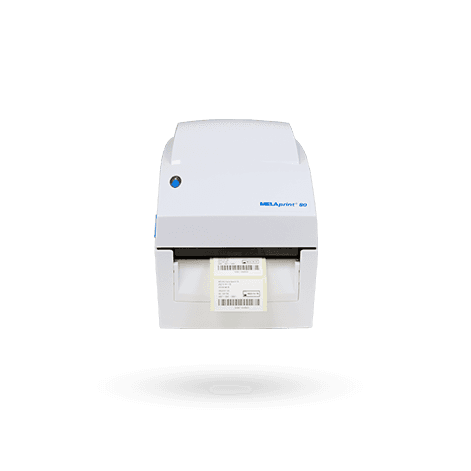
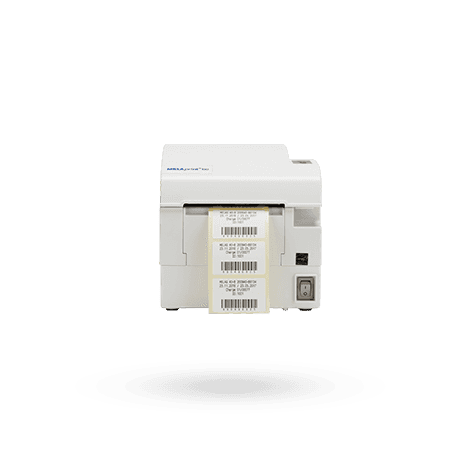
Colored silicone dividers, labels, set numbers, or barcodes enable unambiguous assignment. For example, a tray can be assigned to a specific type of treatment, a reprocessing batch, or a defined loading pattern.
This supports batch documentation and traceability. However, approval remains a professional decision made by authorized personnel and cannot be replaced solely by color coding or a barcode.
The Instrument Cycle with a Wash Tray
The greatest benefit is achieved when the tray system is planned not as a standalone accessory, but as an integral part of a seamless workflow.
1. Compiling the Instrument Set
First, determine which instruments are actually needed for the specific procedure. Unnecessary instruments should not be included in the set simply out of habit, as each instrument must undergo the specified reprocessing procedure after use or contamination.
The instruments are arranged in the wash tray so that they are clearly identifiable and securely held in place. Articulated instruments must be opened, disassembled, or positioned for cleaning in accordance with the manufacturer’s instructions.
The configuration should be documented in an illustrated packing or tray list. This allows the team to quickly verify that everything is present and to reproduce the configuration at any time.
2. Preparation in the Treatment Room
The reprocessed and, if necessary, sterile-packed set is opened only immediately before treatment. The instruments remain clearly arranged and can be removed in a predetermined order.
A well-organized tray thus supports not only hygiene but also treatment assistance. Missing or incorrectly sorted instruments are noticed early on.
3. Safe Collection and Transport
After treatment, the used instruments are returned to the tray, provided this can be done without additional risk and is part of the established workflow. Pointed and sharp ends should be positioned so that no unnecessary risk of injury arises during further handling.
The contaminated wash tray is then transported to the reprocessing room in a closed, sufficiently sturdy, and clearly labeled container. Transporting contaminated instruments through the practice in an open container should be avoided.
4. Cleaning and Disinfection in the RDG
The tray is loaded into the washer-disinfector according to the validated loading pattern. To ensure effective cleaning, water and process chemicals must be able to reach all instrument surfaces.
In particular, the following points must be observed:
Instruments must not completely cover one another.
Spray arms and rinse dead zones must not be obstructed.
Hinges must be sufficiently open.
Liquids must be able to drain from the tray and the instruments.
The maximum load capacity must not be exceeded.
Manufacturer specifications for instruments, trays, and the washer-disinfector must match.
For Class B medical devices, machine-based cleaning and disinfection is generally the method of choice. The DIN-EN-ISO 15883 series describes requirements for cleaning and disinfection machines, their processes, loading trays, validation, and routine monitoring.
Special Considerations for Hollow-Body Instruments
Not every instrument can be adequately cleaned internally simply by placing it in a wash tray. Instruments with lumens, transmission instruments, suction cannulas, or other internal areas may require suitable connectors, adapters, or special holding devices.
Whether an instrument must be connected to an injector system within the tray or separately is determined by the reprocessing instructions provided by the instrument and device manufacturer. The external arrangement within the tray must not result in necessary internal cleaning being omitted.
5. Visual Inspection, Maintenance, and Functional Testing
After the automated process, the tray is removed in the clean area. Even if an RDG program has been successfully completed, the instruments must still be inspected.
The following are checked in particular:
Insufficiently cleaned instruments must not be released for sterilization. They must undergo the specified cleaning and disinfection process again. Damaged instruments or those that can no longer be safely reprocessed are discarded.
Maintenance procedures must be carried out in accordance with the manufacturer’s instructions. Only suitable agents that do not interfere with the subsequent sterilization process may be used.
6. Packaging in the Sterilization Container
If the instruments must be sterile for use, the inspected wash tray is placed in a suitable sterilization container. The filter system, seal, closure, and, if applicable, the tamper-evident seal must be complete and functional.
Before each use, the following should be checked, among other things:
Is the container clean and undamaged?
Are the lid and base dimensionally stable?
Is the seal intact?
Is the filter correctly installed and suitable for its intended use?
Do the closures and latches work properly?
Is the labeling clear?
Does the tray fit into the container without tilting or being overloaded?
Only a packaging system that is assembled according to specifications and suitable for the process can provide the intended sterilization barrier.
7. Sterilization in the Autoclave
The closed container is loaded into the autoclave according to the validated loading pattern. The specifications regarding positioning, stackability, load quantity, and program selection must be followed.
The sterilization program must be suitable for the instruments, the container, and the load. The daily routine load must be covered by the validation or performance qualification of the sterilization process.
An additional tray system changes the loading configuration. Therefore, new tray or container configurations must not be incorporated into routine operations without evaluation. If necessary, the loading patterns must be updated or a new performance assessment conducted.
8. Release and Documentation
After the sterilization process, the process history, relevant parameters, and required batch controls are evaluated. The container is then inspected for dryness, integrity, proper closure, and complete labeling.
Approval must be granted by an authorized and qualified person. This person should be able to unambiguously associate at least the following information:
sterilizer and batch number,
program used,
date of reprocessing,
tray or instrument set,
result of the process control,
Release decision,
Person who approved it.
A successfully completed device program alone does not replace the documented batch and sterilized goods release.
9. Storage and Reissuance
Approved containers are stored under suitable conditions, protected from moisture, contamination, and mechanical damage. The storage system should follow the “first in, first out” principle and allow for clear inventory control.
Before the next treatment, the container is inspected for integrity and brought into the treatment room. Only there is it opened under aseptic conditions, and the tray is prepared.
If the container is damaged, damp, has been opened unintentionally, or is not clearly labeled, its contents must not be used as sterile.
Which instruments are suitable for a tray system?
Tray systems are particularly suitable for regularly recurring instrument combinations. These include, for example, basic instrument sets, prophylaxis sets, and instrument sets for endodontics, periodontology, surgery, or implantology.
However, suitability does not depend solely on size. Before including an instrument, the following questions must be clarified:
Is it suitable for machine cleaning and thermal disinfection?
Can it be reprocessed while secured in the tray?
Do joints need to be opened or parts disassembled?
Does it require internal cleaning via an adapter?
Is it compatible with the process chemicals used?
Is it suitable for steam sterilization?
Is it covered by the validated process?
The manufacturer’s specifications for the medical device take precedence. A tray system can standardize reprocessing, but it cannot compensate for an instrument’s lack of reprocessability.
Here’s what practices should consider when making a selection
A suitable wash tray should not be selected based solely on size or purchase price. The key factor is how well it integrates with existing equipment and processes.
Compatibility: The tray, holders, and containers must be approved for or suitable for use with the existing cleaning and disinfection equipment as well as the autoclave. Usable capacities and loading racks must also be taken into account.
Easy-to-clean design: The tray should feature open surfaces, good water flow, and reliable drainage. Inaccessible crevices and areas where residual water or debris can accumulate are undesirable.
Flexible instrument holders: Silicone bars should be configurable so that different instrument sets can be securely held in place. At the same time, they must not unnecessarily cover the surfaces to be cleaned.
Clear labeling: Color codes , labels, or barcodes facilitate assignment to a specific procedure, set, batch, and storage location. However, color coding should not be the sole form of identification, as colors can be confused or interpreted differently by individual staff members.
Ergonomics and occupational safety: The tray should be easy to grip and transport safely. Sharp instruments must not protrude unprotected from the tray. The weight of a fully loaded tray must also be taken into account in daily use.
Availability of suitable containers: If the instrument setis to be packaged, sterilized, and stored, a compatible sterilization container must be available. The entire system should integrate into the practice workflow without the need for makeshift combinations.
Common Mistakes When Using Wash Trays
A tray system improves processes only if it is properly planned and implemented. Typical mistakes include:
trays that are overloaded,
incorrectly positioned or closed articulating instruments,
hollow instruments that are not properly connected,
holders that cover large areas of the instrument surfaces,
mixing of incomplete treatment sets,
failure to perform visual and functional inspections after the RDG process,
use of the wash tray without a suitable sterile barrier system,
damaged or incorrectly installed container filters,
undocumented changes to tray loading,
use of new sets outside of validated load configurations.
Particularly problematic is the assumption that a properly arranged tray automatically guarantees a hygienically safe result. The verifiable effectiveness of the entire validated reprocessing process remains crucial.
Here’s how a practice successfully implements a tray system
The transition should be carried out in stages. First, the most frequently used instrument combinations are analyzed and grouped into practical sets.
The following procedure is then recommended:
Inventory the instruments and document treatment procedures.
Define suitable instrument sets.
Check compatibility with the instrument washer-disinfector, autoclave, and containers.
Determine tray configurations and document them photographically.
Update work instructions and loading patterns.
Assess the impact on validated processes.
Provide hands-on training to employees.
Initially test the system with selected sets.
Evaluate experiences from treatment and reprocessing.
Optimize the tray configurations as needed.
In doing so, one should not focus solely on maximum device capacity. The key factor is whether the number of trays aligns with the instrument inventory, patient volume, and actual reprocessing cycles.
Conclusion: A Systematic Approach to the Entire Instrument Cycle
A tray system for a dental practice can do far more than simply provide organized instrument storage. When properly planned, it supports the entire workflow—from treatment through cleaning, disinfection, and sterilization to storage and reissuance.
The most important advantages lie in standardization: Instrument sets are clearly organized, need to be rearranged individually less often, and can be more easily monitored, documented, and assigned. This saves valuable work time and, at the same time, helps better protect both instruments and the practice team.
However, hygienic success does not result from the tray alone. It is based on the coordinated interaction of suitable instruments, correct tray configuration, safe transport, validated machine-based cleaning and disinfection, careful inspection, an appropriate sterile barrier system, validated sterilization, and documented release.
A good wash tray therefore does more than just organize instruments—it structures the entire reprocessing process.